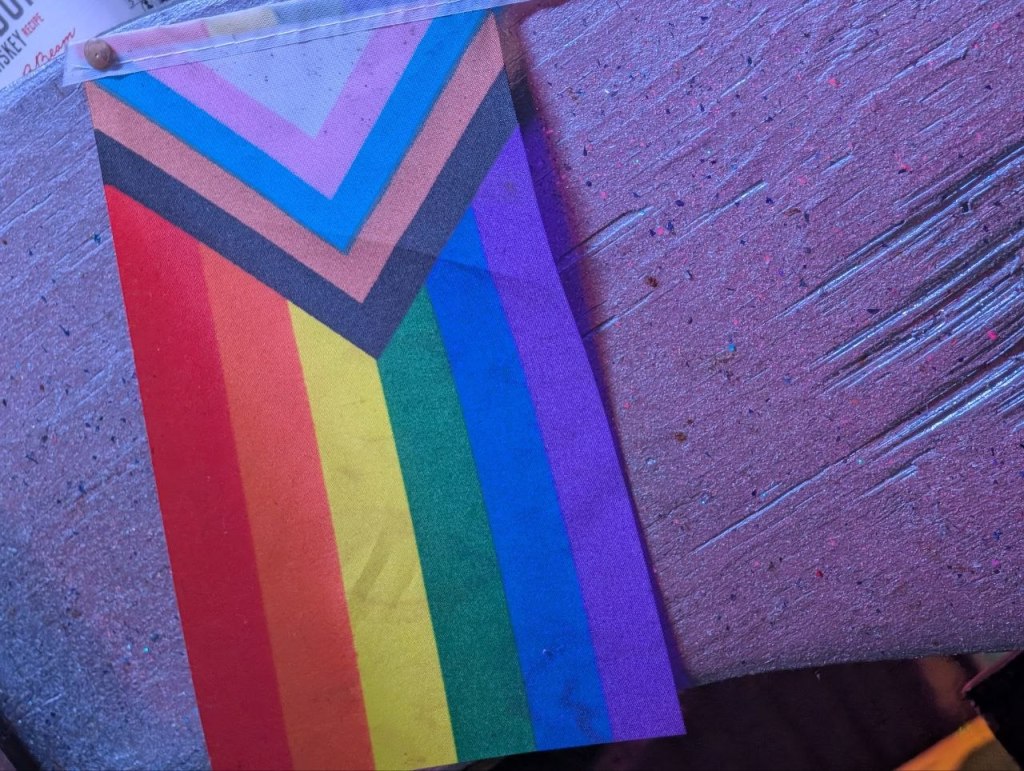
Pride season is here again.
I have just come back from Summer Pride in Gran Canaria. Canterbury Pride is this weekend. After that… The calendar does not stop until October.
And in the middle of all of it, I keep noticing the same thing.
People standing at the edge of the room.
Not because they do not want to be there.
Because something in them has not yet been given permission to arrive.
Pride is supposed to be the celebration of exactly the self-expression that so many of us spent years suppressing. But for some people, watching others move through the world with apparent ease is not inspiring.
It is exhausting.
It is a reminder of something they cannot quite name yet.
This is for those people. This is for the person I once was.
What happens to wanting
This is not a piece about losing yourself. We already have language for that.
What I want to talk about sits underneath it.
What happens to wanting when wanting stops feeling safe?
What happens when your system learns that needs create consequences. That preferences create friction. That wanting too much, too loudly, too specifically risks punishment, or instability, or simply becoming too much for someone else to manage.
After a while, something reorganises.
You become good at anticipation. Good at reading rooms. Good at shaping yourself around what keeps things smooth. What keeps things safe.
And eventually, when someone asks what you want, there is just static.
Not because there is nothing there.
Because access got rerouted.
Mistaking survival reflexes for personality.
That line matters. Because one of the cruelest things prolonged self-suppression does is become indistinguishable from character. The agreeableness. The flexibility. The way you seem to have no particularly strong needs.
Maybe that was not personality.
Maybe it was what staying safe looked like.
Spelunking, not archaeology
A lot of recovery language uses the word archaeology. The idea that you excavate carefully, that something original is preserved down there, waiting to be uncovered and restored.
I am not sure that is always honest.
Sometimes there is no fully intact version of you waiting patiently underground.
Sometimes what got suppressed was not preserved. It was interrupted mid-formation.
What I actually do feels much more like spelunking.
Going into dark spaces without a map.
Doubling back when a passage does not go anywhere.
Returning empty-handed sometimes and accepting that as information rather than failure.
Returning a month later with new light and finding the same chamber looks completely different.
Sometimes finding something alive down there that I was convinced had died years ago.
The goal is not to recover some original untouched version of yourself.
Sometimes it is simply to build the capacity to stay with uncertainty long enough that you stop immediately outsourcing authorship to whoever is in the room with you.
That can look far less graceful than people imagine.
Like freezing when somebody asks where you want to eat.
Like waiting to be chosen.
Like panic arriving the moment you want something specific enough that it could be refused.
If any of that is familiar, it is not a character flaw.
The protection just outlasted the original threat.
Why self-permission is not quite the right frame
There is a lot of language in wellness spaces around self-permission. Give yourself permission to rest. Give yourself permission to want things.
I understand why that framing exists. But for some people it accidentally locates the problem in the wrong place.
It implies the barrier was courage. That if you just gave yourself the green light, the wanting would flow.
But for people whose systems learned, repeatedly and relationally, that desire carried consequences, the barrier is not permission in the abstract.
It is nervous system memory.
The shift is not: I finally let myself want things.
It is: my nervous system stopped assuming that wanting would cost me something.
Those are very different realities.
And conflating them can leave people feeling like they are failing at their own recovery because they know they are allowed to want things and the wanting still will not come.
Your system is being consistent with what it was taught.
Unlearning that is slow work. It is not a decision. It is not a permission slip.
It is repeated, accumulative experience of wanting something and the world not ending.
What silence reveals
Boundaries do not automatically create freedom.
Sometimes they create silence first.
You remove enough external pressure and suddenly there is space. And in that space, you discover how little internally-directed preference survived underneath it all.
That is not liberation. Not immediately.
Sometimes it feels more like vertigo.
I do not think that resolves neatly.
Some days I still freeze when someone asks what I want.
Some days I still catch myself waiting for permission that nobody is withholding.
But I also keep finding things I was convinced had disappeared.
Not recovered.
Found.
And for now, that feels worth paying attention to.
Author’s note Flash is a Trauma-Informed Coach and Mental Health First Aider writing from lived experience within the human pup community. This article is personal reflection and community observation, not clinical guidance. If anything here resonates and you are struggling, please reach out to a qualified mental health professional.
 FLASH MUTT
Leave a comment