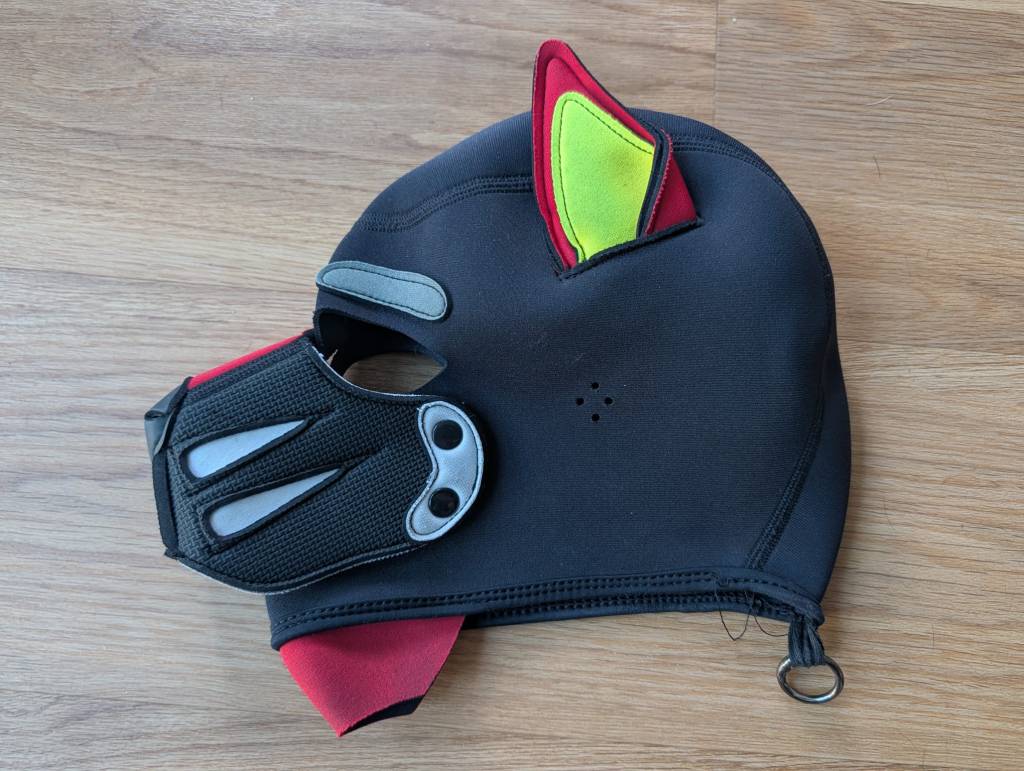
People assume a mask is about hiding.
I don’t experience it that way.
For me, the mask isn’t concealment. It’s containment. Containment creates edges. And edges reduce ambiguity. When the environment becomes legible, I don’t have to scan as hard. I don’t have to calculate. I don’t have to read every micro-shift in the room. My system settles. Not because I’m broken, but because human nervous systems respond to clarity.
Hypervigilance isn’t a flaw. It’s intelligence applied to unpredictability. The issue isn’t that the response exists. It’s that it doesn’t always power down when unpredictability does.
Pup headspace doesn’t cure that. It creates conditions where vigilance isn’t required.
Agreed rules.
Known roles.
Explicit consent.
That’s information. And nervous systems run on information.
When the cost of staying alert drops, something else becomes available.
I won’t call that healing. That’s not my lane. What I can say is what I’ve observed: the energy that usually goes into reading the room moves elsewhere. Into presence. Into play. Into something that feels, for many people, like relief.
There was a moment. No hood, no gear, no dynamic. Just me in conversation. I felt warm. Safe. Unbraced.
And my body wagged.
It happened before I chose it. I almost stopped it, because it wasn’t scene. It wasn’t negotiated. It wasn’t “on.”
That was the first crack in the idea that pup was something I stepped into.
Since then, it hasn’t stopped at the wag.
I greet people I trust by licking the side of their neck or cheek. Not to shock. Not to perform. Reflexively. With consent and awareness, but without internal debate. There’s no “shall I?” There’s just affection moving faster than language.
That speed is only possible because the safety was built first. The consent didn’t happen in the moment. It was established in the relationship. In the trust accumulated over time, in the known dynamic, in the fact that the other person already understood the language my body was speaking. The reflexive warmth isn’t uninhibited. It’s the output of prior negotiation that became so internalised it no longer needs to be spoken aloud. The boundary didn’t vanish. It became fluent.
That’s when I realised this wasn’t just a regulated state anymore.
It had stabilised into trait.
If a behaviour first accessed inside ritualised containment now shows up in everyday life, what does that say about where it belongs?
Research into pup play describes something similar. In a phenomenological study of over ninety puppies and handlers, researchers identified what they called “I-positions”. Aspects of selfhood that don’t have room to exist in ordinary life, but surface through the role. Not a different self. A previously unavailable one.
That reframes the question.
It isn’t “is the mask real?”
It’s “what does the mask make room for, and what happens when that room expands?”
It would be easy to call what I’ve described regression.
But regression narrows capacity.
This has expanded mine.
I’m softer in conflict. Quicker to express affection. Less defended when I’m wrong. More able to receive care without performing competence first.
I spent years assuming my control was identity. The competence. The sharpness. The being-on-top-of-everything. It worked. It made me effective. What I didn’t ask was what it was braced against.
Pup headspace was the first place I put it down long enough to feel the weight of it.
The wag didn’t replace my sharpness.
It complicated it.
And containment deserves scrutiny.
At what point does structure become avoidance? At what point does ritual become rigidity? If the only place the system feels safe enough to soften is inside a defined role, that’s worth examining. Not as accusation. As inquiry.
It’s easy to romanticise subculture as liberation. But what’s happening, physiologically, is regulation. Predictability lowers the need to scan. When I’m not scanning, I’m more present.
I don’t think authenticity is something buried underneath layers, waiting to be excavated.
I think it’s relational.
It emerges in environments where the system no longer has to defend. Pup headspace, for many people, is one of those environments.

 FLASH MUTT
Leave a comment